Hochstamm Suisse
Our work

Hochstamm Suisse
Based in Basel, Hochstamm Suisse is the association that protects and promotes traditional high-stem fruit orchards in Switzerland. It brings together farmers, patrons, partners and processors around a label guaranteeing that all the fruit in a product comes from Swiss high-stem trees: heritage apples from Thurgau, plums from Basel-Land, cherries from Zug or chestnuts from Ticino.
For more than twenty-five years, the association has supported the planting of young trees, orchard biodiversity and regenerative farming, which stores carbon, protects the soil and provides a habitat for many endangered species.
German-to-French translation
In 2026, Hochstamm Suisse entrusted us with the French version of all its materials, to fully address the public in French-speaking Switzerland:
- Website: home page, producer and processor areas, tree-planting and biodiversity support programmes, organisation, menus and legal notice.
- The “Nous cultivons la biodiversité” brochure, set directly into the original InDesign layout.
- The association’s 25th-anniversary magazine.
- Legal and practical documents: articles of association, terms and conditions, brand licence agreement, producer contract, licence, registration and reporting forms.
Every text was checked under the four-eyes principle, then refined with the association’s team up to the final version.
Before and after
The website’s home page, in German and then in its French version, now online.
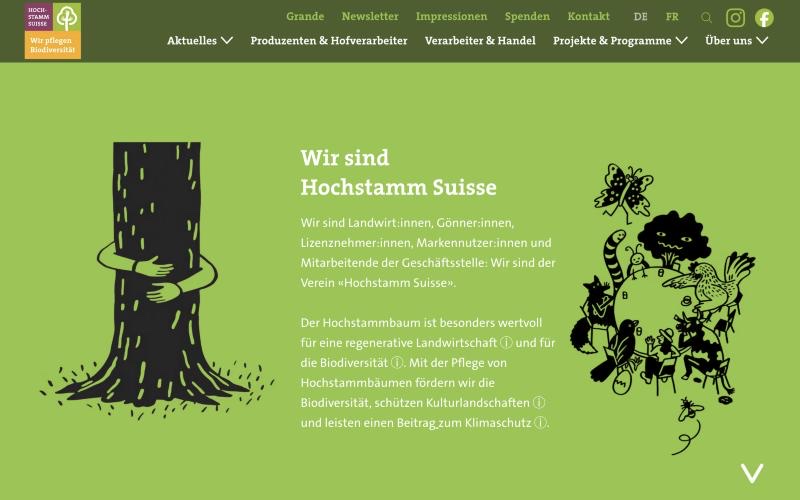
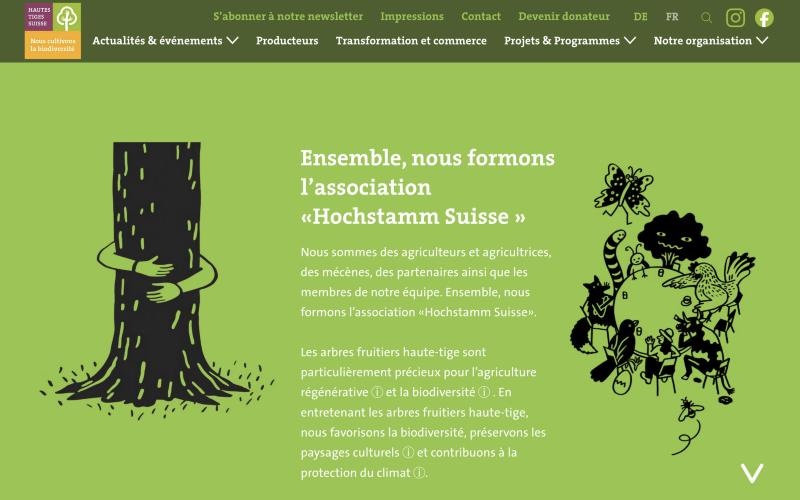
Click the previews to enlarge them, or visit the French website.
Inclusive language, true to the association
Hochstamm Suisse wants everyone to feel included in its texts, a conviction that is part of its identity. In German, the association uses inclusive writing with a colon (Landwirt:innen). French works differently, so we proposed an approach suited to French-speaking Switzerland, based on the recommendations of the University of Geneva.
Together we set a few simple rules, now applied to all the association’s French texts: epicene terms and neutral wording wherever possible and, where the meaning requires it, both forms written out in full, as in “agriculteurs et agricultrices”. Such double forms are still rare in France, but a good translation also embraces the client’s values: we were happy to adapt so that the French version speaks with the same voice as the original.